Showing posts with label books. Show all posts

Sunday, 23 February 2014

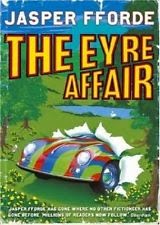
Jasper Fforde's Thursday Next Series

So! After a lengthy hiatus I've got my arse in gear and decided to review what I've read of Jasper Fforde's work, which begins with The Eyre Affair. I was given this book for free by a passer-by, volunteering for World Book Night and was pleasantly surprised to find that I enjoyed it.

It's a little difficult to explain with any kind of brevity the premise of the Thursday Next series. They take place in a parallel universe, essentially quite similar to our own except that steam power prevails over any other technological advancements, the Crimean War is still being fought, time travel is possible and literature is arguably the most important commodity of the human race. It is particularly significant for the protagonist, Thursday, at any rate.  As a law enforcement agent for SpecOps, she works to prevent relatively petty crimes such as forgery -  that is until she becomes swept up by much more bizarre events.

I am currently reading the third of Fforde's seven (and counting, with an eighth to be released soon) book series, entitled The Well of Lost Plots, and although they are not the best written texts in the world - lacking the depth of character that I would count on to make a book really special, and sometimes erring on the side of simplicity, language-wise - I do enjoy them.  Considering how complex some of Fforde's ideas are, including pretty abstract notions such as being able to hear and communicate via footnotes whilst residing within Wordsworth's Daffodils, I personally think that the plainness of his writing is often necessary. If he got too flowery, these books would be very dense and difficult indeed.

On another positive note, the character of Ms Next is extremely likeable. No-nonsense and human, she shoulders the role of a 'strong, independent woman' - clichéd as it sounds - simply by being a regular person. She is funny and competent and caring. She also brings a note of normalcy to the strange, occasionally very far-fetched, world that she inhabits. Being able to relate to the protagonist is the key to my fondness for these books, aided by the elements of science fiction and the supernatural which make appearances throughout.

Finally, I would definitely recommend this series for anyone who considers themselves a bit of a literature geek. As an English graduate, I really appreciated the many references and jokes which rely on a knowledge of literary works, the English language and writing itself. And who doesn't love something that makes you feel smart? I really admire the ability of a writer not to talk down to their readers, and that's another thing Fforde's got going for him.  If you're not into your classics in a big way, it isn't essential to follow the plot or anything, but be warned - you may not enjoy these books as much as the next bookworm. In conclusion, perhaps not the most accomplished saga you will ever read, but some interesting concepts and, above all, a lot of fun.

Monday, 7 October 2013

Everfree (mini post)

So I read Everfree, the third episode in Nick Sagan's dystopian series which began with Idlewild.

My overall thoughts were that it was a little disappointing. I'm not sure if it's because I was younger when I read the first two or because the author had a lot of plot to fit into a single novel (the entire reconstruction of humanity no less), but it seemed a little two-dimensional. The amount of things that happened left little space for character development - arguably not as necessary since they have all been introduced previously, but still extremely important I feel. This also resulted in the action feeling a bit rushed and lacking in impact.

On the plus side, the book does wrap up the story pretty well. It wasn't a struggle to get through and my prior attachment to the characters and knowledge of their history carried me through, making me care about their fates. It isn't a terrible book, nor is it a great one. I was as whelmed as whelmed can be.

This is just a short post as I don't like to slate things - the point of this blog is to big up little known but accomplished artists, but I hinted that I would report back on this novel so I thought I would follow through - this also serves to prove that I can be discerning (I don't just love everything!), so it might lend my taste some integrity.

Stay tuned for a proper post soon :)

Saturday, 17 August 2013

Haunted

Chuck Palahniuk is best known for his novel Fight Club, which became the incredibly successful cult movie directed by David Fincher. Fight Club is probably the novel I enjoyed least by Palahniuk however - perhaps because I was already such a big fan of the film and it therefore seemed to hold nothing new for me (I had the same problem with King's The Green Mile when I finally read it last year).  Haunted was the first book of his that I read, and it's a strange one that's for sure. Nevertheless it secured my appreciation for Palahniuk's work and I have subsequently worked my way through most of his bibliography.

Part of what makes Haunted so engaging is its unusual format: a series of short stories embedded into the main plot and authored by the main characters. The over-arching plot centres on a group of writers attempting to 'find' their masterpiece by taking part in a retreat based on the visit made by Lord Byron and Mary Shelley amongst others to the Villa Diotati in 1816 (this is where Shelley came up with the idea for Frankenstein).  The characters are known only by nicknames which are explained in the short stories making up every other chapter and providing autobiographical information in flash-back form.

When the writers are unexpectedly trapped in the abandoned theatre they have chosen as their hermitage, in true dark and surreal style from Palahniuk they do not behave as expected. Each writer more desperate for fame than anything else, they endeavour to make their situation worse in the knowledge that a harrowing, near-death experience will give their story importance and mystery when they are inevitably rescued. Cue wastage of the dwindling food supplies, self-mutilation and plots to sabotage the other residents (each character reasoning that the fewer survivors, the better their story).

As is always the case with Palahniuk's writing, both the mini back stories and the events which transpire within the framing narrative are often gruesome, graphic and shocking. Be prepared for necrophilia, cannibalism, suicide and much more as the tale unfolds. The writer's - clearly - odd imagination births a series of disturbing scenes which create a satirical view of modern life and the pursuit of fame and integrity. This is a mood which runs through all of Chuck Palahniuk's work (I would recommend Choke and Lullaby as two more of my favourites as well).

The macabre and almost nightmarish feel of this cult writer's work, along with the cynicism of his narrators and post-modern writing style, really emphasises his message about people's ability to distance themselves from the horrors of modern life. He paints a shallow, vindictive picture of society - almost comical in its cruelty - which, although entertaining and thought provoking, could definitely get you down if you read too much at once.

Thursday, 11 July 2013

Idlewild and Edenborn

I'm not sure if Nick Sagan's dystopian trilogy technically falls into the 'young-adult' category. I read them when I was quite young but I don't set much store by those age restrictions in literature - if it's good it's good. Actually that goes for anything really, I mean everyone likes Toy Story, right? Why should you feel guilty or 'uncultured' just because it's animated and there aren't any naughty words?

Idlewild does revolve around a group of teenagers - set in the near future, they attend a school where virtual reality is used as a teaching tool and also by the students to create their own little worlds in which to socialise and/or reflect. The interactions within the group are realistic and relatable; prejudices and tiffs amongst the boys and girls blown up into dramatic rivalries that seem like the be all and end all of existence - just like real high school. However, they are to find out that they are woefully mistaken, and not in any kind of easy or gradual way.

The narrator is Halloween, one of the teenagers who wakes one day with no memory, only the certainty that someone has tried to murder him. His attempts to remember who he is and what happened aren't helped by the insane virtual environment he has created for himself over the years, or by their seemingly sadistic tutor Maestro.

I'm hesitant to give out spoilers (although the blurb does hint at the story's trajectory) so if you want to go into these books blind, STOP READING NOW.


... so around 20 years before we join Halloween and his friends, a plague has wiped out all of mankind. The ten teenagers were genetically modified and placed inside a virtual reality designed to condition them into perfect pillars of a new human race. It doesn't quite go to the dead scientists' plan though and their release from the computer world becomes fraught with danger and fear.

I think what I like about this book, aside from its gothic and sci-fi overtones, is that at its heart it is a classic whodunnit. A mysterious crime, a limited number of suspects and a cool narrator, determined to get to the truth. And he is pretty cool, our Halloween. I used to have a bit of a crush on him, insofar as you can fancy a written description of a fictional person.

The second book in the series, Edenborn, follows the characters as they attempt to restart society on an empty Earth.  They have split into two camps: one believes they should just rebuild humanity as it was and the other that the people they create should be improved genetically.  I actually read this second installment first, because I was a strange child. A maverick some might say. I still enjoyed both books although I think the first one would have been more surprising and the second would have made more sense if I'd come to them in the correct order.

Perhaps my favourite element of Edenborn is the girls' sociopathic daughter Penny and her relationship with Halloween's misanthropic son, their teenage angst leading them to disaster whilst the grown-ups remain distracted by the bigger picture.


Both novels are very good, with three-dimensional characters and interesting concepts at their heart. I only recently found out that the third book, Everfree, exists and I plan to read it soon, so I may review it here. Watch this space you lucky people!

Sunday, 2 June 2013

Transition

Iain Banks is a very well-known writer so this may not seem an appropriate book to review, but as a science fiction novel (not written however, under his sci-fi moniker of Iain M. Banks), this one may have slipped through the cracks slightly; none of my friends who are fans of his have read it.  Even if it's not obscure enough I don't care - anyone who hasn't read it, should.  And since the recent news about his terminal cancer diagnosis, it seems germane to pay tribute to one of my favourite British authors.  The world will be a lesser place without him.


Transition is set in a world wherein the existence of parallel universes had been proven.  Selected people are able to travel, or transition, between these universes with the aid of a drug developed by the inhabitants of an adjoining Earth known as Calbefraques.  These people are overseen and governed by an all-seeing and corrupt parliamentary council known as The Concern.

The characters followed during the novel are largely from the aforementioned version of Earth although they flit between various universes, including our own.  The main protagonist is a hired assassin called Temudjin Oh, enlisted by The Concern to perform tasks of varying skill, violence and size to aid the manipulation of history in multiple worlds.  Through the eyes of those with a clear view of the Concern's overall intentions (such as the mysterious Mrs Mulverhill and the psychopathic Madame d'Ortolan) as well as relatively ignorant outsiders like the cynical entrepreneur Adrian Cubbish of London, Earth (ours), we see the effects of The Concern's actions and the uprising of those intent upon bringing them to an end.

With a twisting and turning plot entangling Temudjin in a battle of political interests, revolutionaries, dangerous experimentation and lethal missions, the storyline gradually unfolds, drawing you in.  Iain Banks has achieved that rare quality in a work of fiction - a storyline rich and complex enough to intrigue and entice the reader, without alienating them with unnecessarily convoluted descriptions or back stories.  It is as complicated as it needs to be without it becoming a negative thing (a fine line often tripped upon, especially by sci-fi and fantasy writers).

Fun, exciting, sexy, filled with action and interesting characters, Transition fulfils everything you could want from a sci-fi novel.  Perfectly crafted and brilliantly written, it's definitely worth a read even if you don't usually go for this genre.
               
Iain Banks